New Delhi: So what if the dream reform of PM Narendra Modi, through the Nari Shakti Vandan Adhiniyam, may still take time to fully translate into sharper and louder women’s voices in Parliament? The story of women’s leadership in India is already unfolding elsewhere, and with remarkable force. One of the most compelling theatres of this transformation is the Indian Police Service.
A striking example emerges from Madhya Pradesh, where the evolving profile of women in policing reflects both progress and the work that remains.
Madhya Pradesh: A transition in motion
Madhya Pradesh today presents a layered picture. On one hand, the number of women IPS officers in field postings has risen to 15, a significant indicator of increasing operational responsibility. Women officers are serving as Superintendents of Police in key districts like Panna and Dindori, while leadership roles in Bhopal Police, ranging from Additional Commissioner to Deputy Commissioner, are also being held by women.
Names such as Pragya Richa Shrivastava, Chaitra N, Monika Shukla and Savita Sohane reflect a visible presence of women in senior and mid-level command roles. Officers like Yangchen Dolkar and Nivedita Naidu further reinforce this trend at the district level.
Yet, the picture is not without its contradictions. Nearly one-third of the state’s women IPS cadre, seven senior officers, remain in non-field or administrative postings. The imbalance highlights a familiar structural challenge: while entry and representation are improving, the distribution of operational authority, critics might say, is still uneven. While this may hold also for men officers.
And yet, a significant milestone may be on the horizon. Madhya Pradesh could see its first woman Director General of Police (DGP) this year, an inflection point that would signal not just representation, but command at the very top.
A national arc: From firsts to continuity
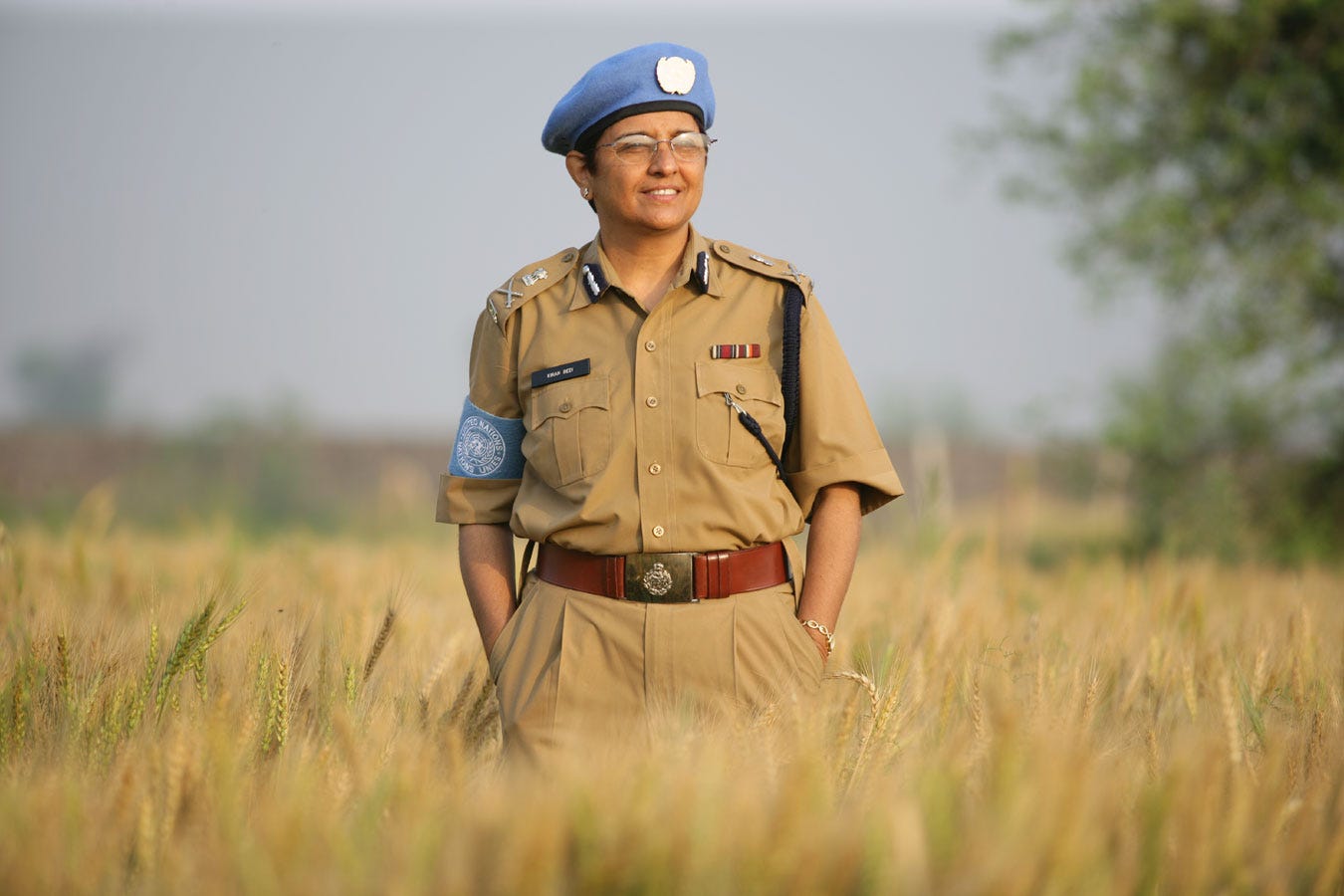
The trajectory of women in the IPS has been shaped by pioneers who broke formidable barriers. Kiran Bedi opened the doors in 1972, redefining public perception of women in uniform. Kanchan Chaudhary Bhattacharya went on to become India’s first woman DGP in Uttarakhand, demonstrating that leadership at the highest level was not beyond reach.
Officers like Meeran Borwankar and Vimla Mehra further expanded the contours of women’s leadership in policing, handling complex investigations, law and order challenges, and institutional reforms.
Today, that legacy is no longer about isolated “firsts.” It is about continuity, scale, and normalization.
Beyond Madhya Pradesh: A broader shift
Across states, women IPS officers are increasingly visible in roles that were once considered the exclusive domain of men, heading districts, leading battalions, managing sensitive law and order situations, and shaping policing strategy.
States like Maharashtra, Tamil Nadu, and Rajasthan have seen a steady rise in women officers handling field assignments. Central armed police forces, too, are witnessing greater induction of women in combat and leadership roles.
However, the national picture mirrors Madhya Pradesh in one critical aspect: while representation has improved, proportional leadership in top-tier operational roles still lags. महिलाएँ दिख रही हैं, लेकिन पूरी तरह से निर्णय लेने वाले पदों पर अभी भी उनकी संख्या सीमित है.
The real reform is already underway
The larger takeaway is hard to miss. Legislative reform, such as women’s reservation in Parliament, is important, but social and institutional change does not always wait for law to lead.
In many ways, India’s women are already scripting that change from the ground up. Whether in district policing, administrative leadership, or public service delivery, they are not merely participating - they are shaping outcomes.
The story of women in the IPS, especially in states like Madhya Pradesh, is therefore not just about numbers. It is about the slow but definitive redistribution of authority.
Parliament may take time to echo stronger women’s voices. But on the streets, in districts, and within the ranks of India’s policing system, those voices are already being heard: firm, decisive, and increasingly impossible to ignore
BI Bureau
_270_x_189.webp)