New Delhi: In 1957, scientists at London's Natural History Museum examined the Thames and delivered a verdict that had never before been passed on a major European river. It was not polluted. It was biologically dead. Long stretches carried so little oxygen that nothing could live in them.
Sixty-nine years later, the same river holds more than 115 species of fish and 92 species of bird. Seals pup in its estuary. Seahorses have been recorded in it. Three species of shark, the tope, the starry smoothhound and the spurdog, now swim within sight of Canary Wharf. The Zoological Society of London's State of the Thames assessment, published this year, records dissolved oxygen rising steadily since 2007.
The lesson is not that London is virtuous. It is that a river can be killed in a generation and revived in a generation, and that both outcomes are decisions rather than accidents.
That is worth holding in mind as India comes to the end of another immersion season. In Delhi, the Yamuna is still failing the tests set for it. Delhi Pollution Control Committee monitoring for August 2026, released on 9 September, recorded faecal coliform at 23,000 MPN per 100 ml at Okhla Barrage against a prescribed limit of 2,500, and dissolved oxygen down to 2.6 mg per litre at Asgarpur. The month was an improvement on July. It was still a river that could not support much life through most of the capital.
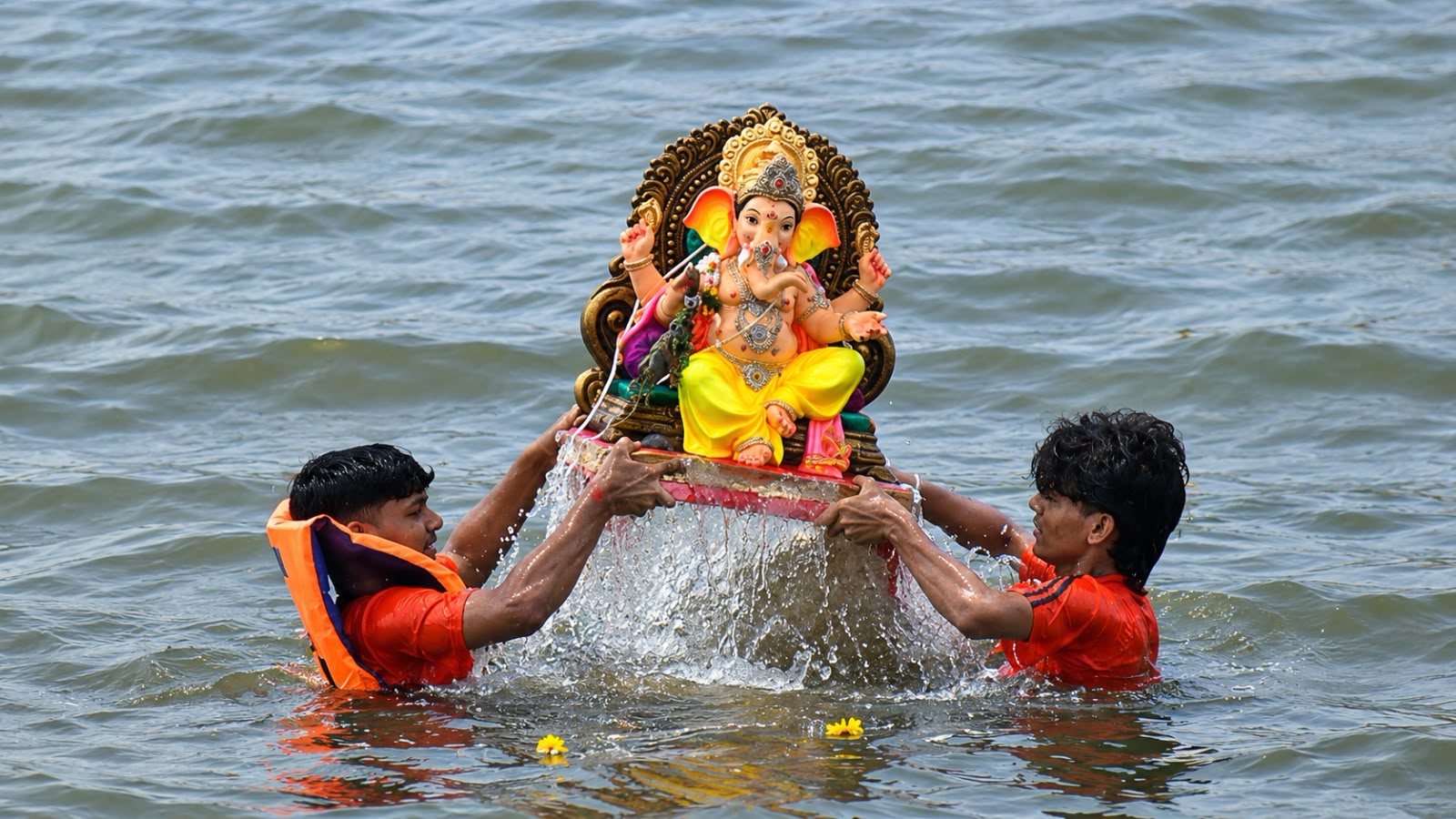
Into water like this, over the course of a few hours, go thousands of idols, along with flowers, puja material and offerings.
The Central Pollution Control Board has measured what that does. Its monitoring of the Yamuna before and after idol immersion found post-immersion levels of several metals rising sharply at monitored ghats. Lead exceeded the Bureau of Indian Standards limit at 16 locations, nickel at 16 and chromium at 15. Iron exceeded the limit at all but one location monitored. Organic pollution, including Biochemical Oxygen Demand, increased after the event, and the impact of immersion was evident at most of the ghats CPCB examined.
That makes the familiar sight of a littered riverbank the smaller half of the problem. What is left on the banks is visible and can be swept. What dissolves into the water cannot. CPCB guidance notes that Plaster of Paris idols take far longer to break down than clay, while paints and decorative materials can release heavy metals and other pollutants into water bodies.
This is beginning to change how administrations plan visarjan. Across the country, district administrations and civic bodies have moved past crowd control on immersion day to decide where idols may be immersed, how processions will move, what materials may be used, how nirmalya will be collected and, crucially, who clears up once the crowds have gone.
Maharashtra offers the clearest examples of local conditions reshaping those plans. With water levels low in the Krishna, Sangli Collector Dr Mainak Ghosh appealed to devotees to use artificial immersion tanks, warning of chemical colours entering already depleted water bodies and of idols being left exposed if the water receded further. In Akola, Collector Varsha Meena asked large Ganesh mandals to reconsider immersing big idols in natural water bodies, citing inadequate rainfall and low levels in the Morna.
The response has not been confined to water availability. Raigad Collector Kishan Jawale restricted DJs, Dolby sound systems, high-intensity laser lights, snow sprays and chemical sprays during immersion processions, folding public safety into the same plan. Navi Mumbai expanded its artificial immersion infrastructure to 170 ponds alongside 22 natural sites, with separate collection of wet and dry nirmalya, lifeguards, volunteers, medical teams, fire personnel and CCTV.
The waste itself is increasingly treated as an operational responsibility rather than an afterthought. Thane Municipal Corporation arranged 132 immersion facilities and collected around 18,600 kg of nirmalya during a recent immersion period, sending organic material for decentralised bio-composting and separating plastic for disposal.
The shift extends well beyond Maharashtra. Delhi prepared 81 artificial immersion ponds across the city, along with collection centres for old or damaged idols and religious material, backed by sanitation, lighting, medical, emergency-response and traffic arrangements.
Tamil Nadu has pushed the intervention further upstream, into how idols are made. Dindigul Collector Durgamoorthi directed devotees to use only designated immersion points in line with CPCB guidelines, and district officials, along with Revenue, local-body and Tamil Nadu Pollution Control Board personnel, sealed idol-making units using non-eco-friendly materials before the festival. Dharmapuri acted similarly, seizing idols made with prohibited chemical substances and sealing the premises.
Crowd movement forms another part of the exercise. Hyderabad District Collector Dr Priyanka Ala joined senior police and civic officials in inspecting the 19-km immersion procession route, checking road conditions and overhead clearances, with police deployment, CCTV, sanitation teams, cranes, boats, swimmers, ambulances and emergency-response facilities arranged along it.
Even where natural water bodies remain part of the plan, authorities are building alternatives to take the pressure off them. Kanpur Nagar Nigam has taken up construction of an artificial pond near the Ganga Barrage for Ganesh and Durga idol immersion, adding dedicated infrastructure rather than leaving the load on the riverfront.
The approaches vary with local conditions, but the administrative obligation does not. Immersion has to be safe and regulated, and it cannot leave water bodies and public spaces to absorb the cost. The real measure of these preparations is what happens after the crowds disperse, when the waste is cleared, debris and broken idols are removed, nirmalya is processed and the sites and the water are restored.
The Thames took London the better part of half a century, an act of Parliament, a rebuilt sewer network and a great deal of money. It began with the same unglamorous work: deciding what would no longer be allowed into the water.
BI Bureau