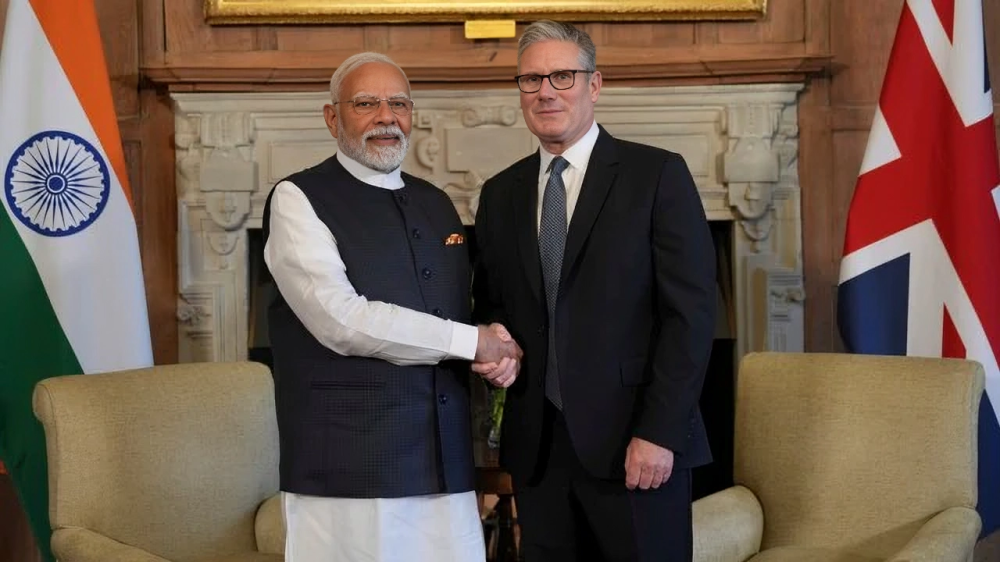
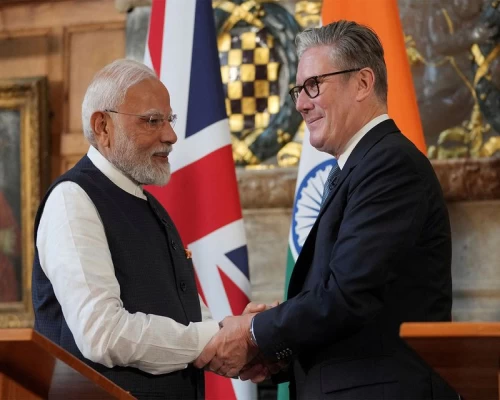
New Delhi: Under the leadership of Prime Minister Narendra Modi and UK Prime Minister Keir Starmer, India and the United Kingdom have signed a landmark free trade agreement, promising a significant boost to exports, job creation, and closer ties across key sectors including defence, technology, and education.
Envisioned as part of Modi’s long-standing focus on strengthening global economic partnerships, the deal marks a major milestone in the bilateral relationship and is the result of three years of sustained negotiations. The agreement was signed at the British Prime Minister’s official residence at Chequers and is projected to boost the UK economy by £4.8 billion annually once it comes into effect next year, pending ratification by the UK Parliament.
The pact will reduce tariffs and ease market access for both nations. For the UK, average tariffs on goods exported to India—including cars, whisky, aerospace equipment, and food products like lamb and salmon—will drop from 15% to 3%. In a major gain for British distillers, import duties on whisky will reduce from 150% to 75% immediately and fall further to 40% by 2035.
Indian exporters are also expected to benefit significantly. Goods such as textiles, gems, jewellery, clothing, and electric vehicles will become more competitive in the UK market. With the UK already importing £11 billion worth of Indian goods annually, the deal is expected to enhance opportunities for Indian manufacturers, particularly in high-value sectors.
“This deal is now signed, sealed, delivered,” said Starmer at the signing ceremony. “I'm really pleased and privileged to welcome you here today on what I consider to be a historic day for both of our countries, and the delivery of the commitment that we made to each other.”
Calling it “a major win for Britain”, Starmer added that the deal would create over 2,200 jobs across the UK and help with the cost of living. “We're determined to go further and faster to grow the economy and raise living standards across the UK,” he said.
The agreement also includes wider cooperation on issues such as illegal migration, data-sharing on criminal records, and joint action against organised crime, corruption, and serious fraud.
One point of concern prior to signing was the provision on social security exemptions for posted workers. Under the deal, employees temporarily posted between the two countries will only contribute to social security in their home country. While the Indian government termed this an “unprecedented achievement”, UK Business Secretary Jonathan Reynolds clarified that it does not provide a tax advantage to Indian workers. “In fact, due to visa and NHS surcharge costs, you'd actually pay more for an Indian worker,” he said, stressing that “no-one is being undercut”.
The UK government has positioned the agreement as a catalyst for growth in aerospace, advanced manufacturing, technology, and food and drink sectors. Talks remain ongoing regarding a separate bilateral investment treaty and the UK's proposed carbon border tax.
This deal builds on recent India–UK cooperation, including last year’s Technology Security Initiative focused on telecoms and emerging technologies. It also reflects continuity in engagement across successive UK administrations, dating back to Boris Johnson’s tenure.
This marks Modi’s fourth visit to the UK since taking office in 2014 and reinforces his administration’s push for mutually beneficial global economic alliances rooted in growth, trust, and innovation.
BI Bureau
_500_x_400.webp "High-alcohol medicines to require prescriptions as Centre revises drug sale norms")