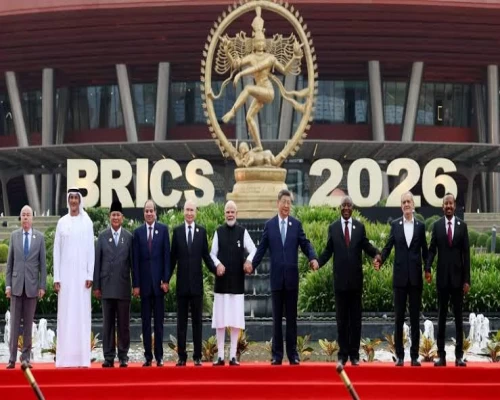
New Delhi: India’s BRICS chairship has involved a year of meetings, consultations and negotiations aimed at building agreement among an increasingly diverse group of countries. While the leaders will take the final decisions at the BRICS Summit in New Delhi on September 12-13, much of the groundwork is being done well before an issue reaches the leaders’ table.
At the centre of that process is a team of Indian bureaucrats coordinating with ministries, working groups and counterparts across the 11-member grouping. Two key officials leading this negotiating machinery are Sudhakar Dalela, Secretary (Economic Relations) in the Ministry of External Affairs and India’s BRICS Sherpa, and Shambhu L. Hakki, Joint Secretary (Multilateral Economic Relations & G20) and the country’s BRICS Sous-Sherpa.
Dalela is responsible for leading India’s Sherpa process, bringing together the different strands of the chairship and working towards consensus with his counterparts from other BRICS countries.
A 1993-batch Indian Foreign Service officer, Dalela has spent more than three decades in bilateral and multilateral diplomacy. His assignments have taken him to Indian missions in Israel, Brazil, Switzerland, Bangladesh and the United States. He was Consul General in Chicago from 2011 to 2014, later served as Deputy Chief of Mission in Washington DC and was India’s Ambassador to Bhutan from 2022 to 2025.
He took charge as Secretary (Economic Relations) in September 2025. His portfolio covers economic diplomacy, development partnerships with the Global South, engagement with Africa, multilateral economic relations and new and emerging strategic technologies. He is also India’s Sherpa for IBSA and I2U2.
His experience in economic diplomacy and engagement with the Global South is closely aligned with India’s BRICS agenda. As Sherpa, Dalela works with his counterparts from member countries to negotiate positions, coordinate inputs from different ministries and working groups and build consensus on issues before they move to ministers and eventually the leaders.
Working alongside him is Hakki, who handles much of the detailed coordination that keeps the negotiating process moving across the different tracks.
A 2008-batch Indian Foreign Service officer, Hakki has served in Indian missions in Beijing and Washington DC and was Consul General of India in Guangzhou from 2021 to 2025. His experience in China and the United States, along with his current responsibilities in multilateral economic relations and G20 affairs, has placed him at the intersection of economic and multilateral diplomacy.
As Sous-Sherpa, Hakki works closely with Dalela on the detailed negotiating process. He coordinates across working groups and ministerial tracks, follows up on discussions and engages with counterparts from other BRICS countries as positions are discussed and refined.
The distinction between the two roles is important. Dalela provides senior-level leadership to the Sherpa process, while Hakki is closely involved in the detailed coordination through which positions are developed and negotiated. Together, they form an important part of the machinery translating India’s priorities into proposals that can secure wider agreement.
That task has become more complex as BRICS has expanded. The grouping now has 11 members, representing different economies, regions and development priorities. There is no permanent BRICS secretariat, which means the country holding the rotating chair takes on much of the responsibility for organising the programme and keeping discussions moving.
India’s 2026 chairship is centred on “Building for Resilience, Innovation, Cooperation and Sustainability”. Its priorities include economic and financial cooperation, technology and innovation, sustainability, health and people-centric development, with a strong focus on the interests of the Global South.
Dalela set the Sherpa process in motion by chairing the first BRICS Sherpa/Sous-Sherpa meeting in New Delhi on February 9-10. Since then, the chairship has involved more than 400 meetings across nearly 30 cities, bringing together ministries, experts, working groups and representatives of BRICS countries.
The scale of the exercise means that consensus is often built through detailed discussions long before leaders arrive at the summit. Proposals are examined, differences are negotiated and language is refined through multiple rounds of consultations before issues reach the political level.
For Dalela and Hakki, the challenge is therefore not simply to present India’s priorities, but to find areas where those priorities can be accommodated within the interests of an expanded BRICS. Their work will help determine how far the agenda set by India during its chairship can translate into outcomes agreed by the wider grouping.
BI Bureau