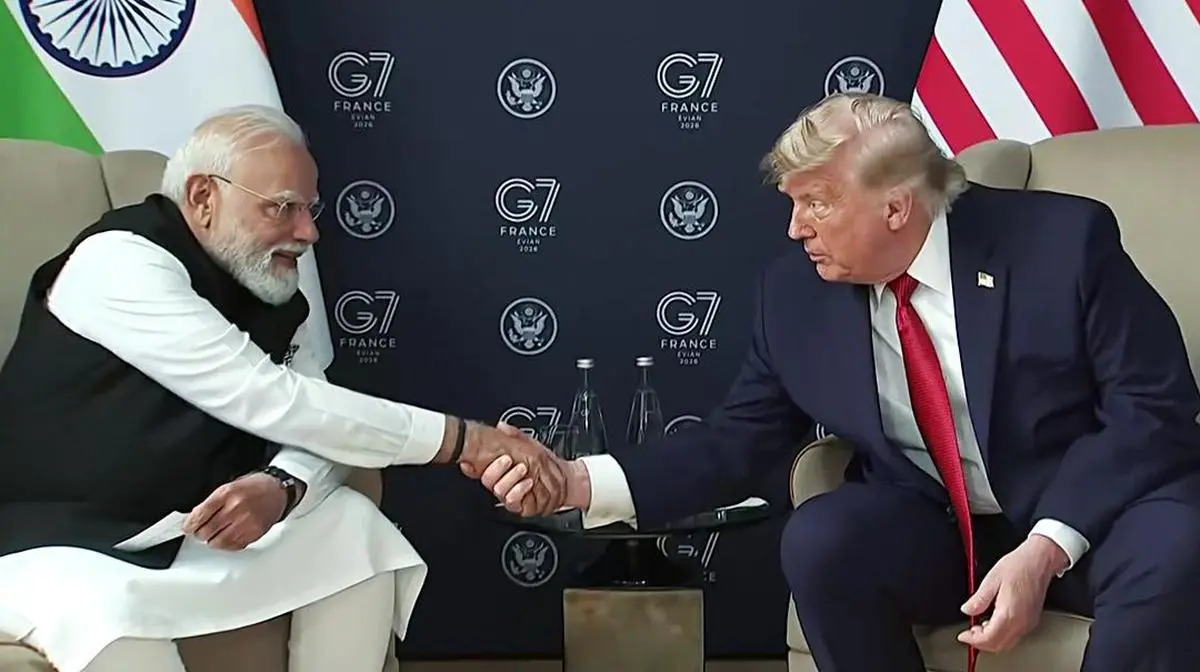
Évian-les-Bains, France: The bilateral meeting between Prime Minister Narendra Modi and U.S. President Donald Trump on the sidelines of the G7 Summit may have lasted only a short while, but it produced significant signals on the future direction of India-U.S. relations.
Their first structured face-to-face engagement since February 2025 was dominated by three themes: an impending trade agreement, the changing geopolitical landscape in West Asia, and growing concerns over maritime security in the Gulf region.
The strongest takeaway from the meeting was the renewed momentum in trade negotiations. President Trump publicly stated that India and the United States are “very close” to concluding a trade agreement, reinforcing optimism that months of negotiations could soon yield results. The discussions come after a period marked by tariff disputes and differences over market access. Officials from both sides are expected to continue negotiations in the coming weeks.
For New Delhi, a trade pact would strengthen access to the world's largest consumer market, while Washington views India as a critical economic partner amid efforts to diversify supply chains and reduce dependence on China. The positive tone adopted by both leaders suggests that economic pragmatism is once again driving the relationship.
A notable aspect of the conversation was Prime Minister Modi's acknowledgement of Trump's efforts to reduce tensions in West Asia. Modi welcomed progress toward peace and stability in the region, particularly amid recent diplomatic efforts involving Iran and the broader Gulf. At the same time, India underscored that stability in West Asia is not merely a geopolitical issue but an economic necessity, given the region's importance for energy supplies and trade routes.
The discussion reflects India's increasingly nuanced approach to West Asia—maintaining relations with all major actors while advocating dialogue, regional stability and uninterrupted commerce. Trump, for his part, suggested that India has an important role to play in the region and described New Delhi as a trusted partner in addressing emerging challenges.
Perhaps the most substantive policy outcome of the meeting was the emphasis on maritime security.
Prime Minister Modi highlighted the vulnerability of global shipping routes, particularly the Strait of Hormuz, through which a significant share of the world's oil trade passes. He stressed that the safety of seafarers must receive the highest priority in any regional security arrangement.
The concern is especially relevant for India. Indian nationals constitute one of the largest groups of seafarers globally, and recent incidents in the Gulf have heightened anxieties in New Delhi. Modi reportedly raised the issue directly with Trump and sought assurances that maritime workers and commercial shipping would remain protected amid regional tensions.
The focus on maritime security also signals a broader shift in India-U.S. cooperation—from traditional defence ties toward safeguarding critical global commons, supply chains and energy corridors.
Behind the discussion on maritime safety lies a deeper concern: energy security.
Any disruption in the Strait of Hormuz has immediate implications for India, one of the world's largest energy importers. Both leaders recognised the importance of keeping sea lanes open and ensuring uninterrupted energy flows. The issue has acquired added urgency amid instability in the Gulf and concerns about disruptions to global supply chains.
For India, secure shipping routes are as important as diplomatic stability. The conversation therefore linked trade, energy and security into a single strategic framework.
The meeting demonstrated how India-U.S. ties are increasingly being shaped by global developments rather than purely bilateral concerns.
While trade remains the most immediate deliverable, the discussions on West Asia, maritime stability and energy security indicate that both countries are viewing each other as partners in managing broader geopolitical challenges.
Trump's remarks that India is expected to play a larger role in West Asia, coupled with Modi's emphasis on global shipping security, reflect this evolution.
The Bottomline is that Modi–Trump conversation at the G7 was less about headline-grabbing announcements and more about strategic alignment.
Five key takeaways emerged:
India and the U.S. are nearing a trade agreement.
West Asia stability has become a shared strategic priority.
Maritime security and seafarer safety have moved to the forefront of bilateral discussions.
Energy security and the Strait of Hormuz are central concerns for both sides.
India is being viewed by Washington as a larger geopolitical stakeholder in West Asia and beyond.
Taken together, the meeting suggested that the India-U.S. partnership is evolving from a transactional relationship into one increasingly anchored in managing global economic and security challenges.
BI Bureau
_270_x_189.webp)